
Why Pricing Strategies Fail in Execution Even When They Are Right
Many organizations invest significant time and effort defining pricing strategy. Market positioning is clear. Target segments are well understood. Value propositions are articulated. Financial objectives are aligned. At a strategic level, pricing intent is often sound.
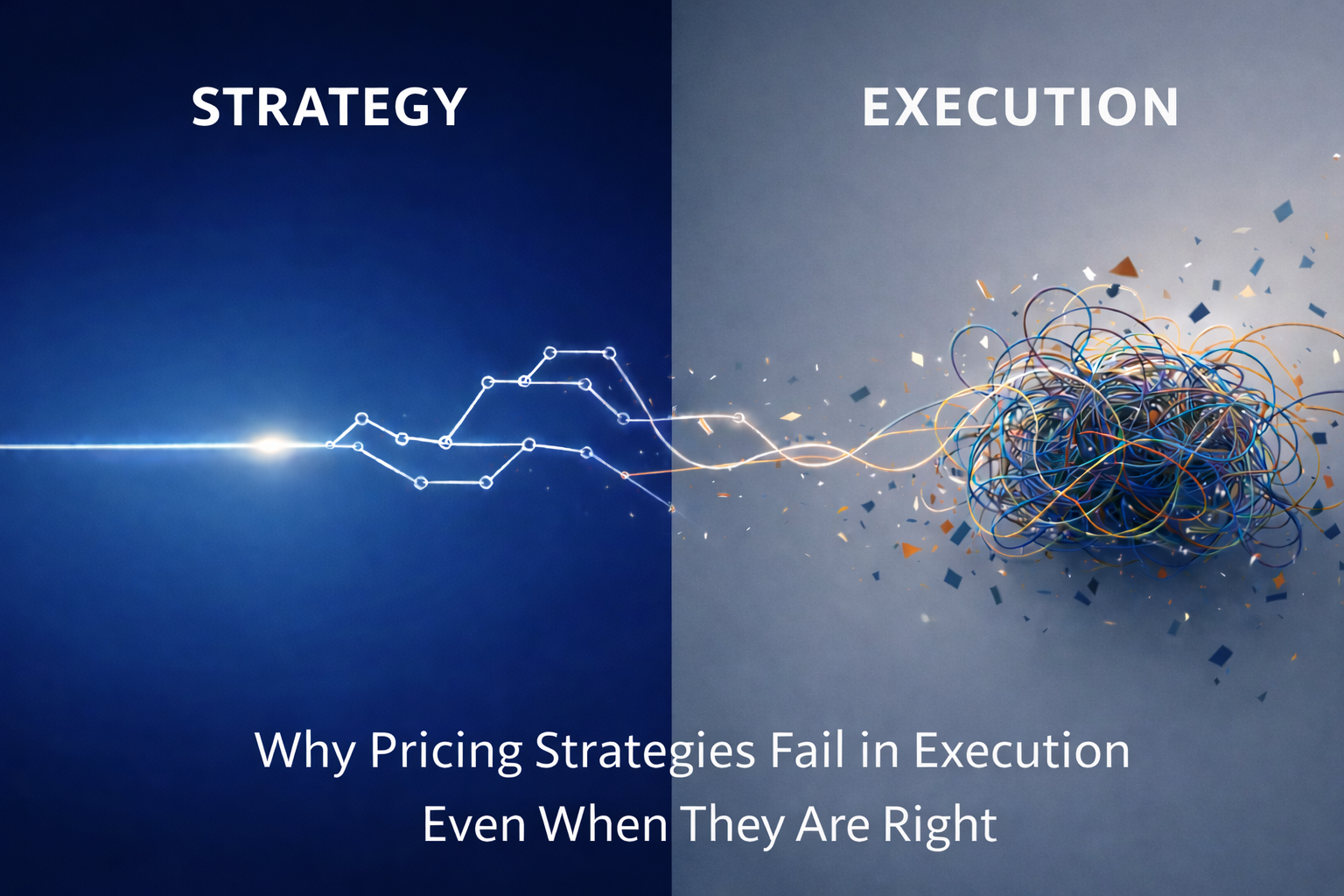
Why Pricing Strategies Fail in Execution Even When They Are Right
Many organizations invest significant time and effort defining pricing strategy. Market positioning is clear. Target segments are well understood. Value propositions are articulated. Financial objectives are aligned. At a strategic level, pricing intent is often sound.
The challenge does not begin with strategy.
It begins when that intent moves into execution.
As pricing decisions are operationalized, they must function within real world conditions that are far more complex than planning assumptions suggest. Markets behave differently by region and channel. Customer agreements introduce non standard structures. Incentives, rebates, and discounts layer additional logic. Competitive dynamics evolve faster than pricing benchmarks can be refreshed.
What was once a manageable set of pricing decisions expands quickly into hundreds or thousands of combinations that must be calculated, approved, governed, deployed, and maintained.
When execution models are not designed for this level of complexity, pricing intent begins to erode.
The execution gap
In many organizations, pricing execution relies on tools and processes that were never intended to support dynamic, multi dimensional pricing at scale. Spreadsheets remain the primary mechanism for modeling, applying, and adjusting prices. Approvals are managed through email or informal workflows. Logic is duplicated across systems with subtle variation.
Each exception introduces a workaround.
Each workaround becomes embedded practice.
Each embedded practice increases the gap between pricing intent and pricing reality.
This erosion is rarely visible in isolation. It accumulates gradually across transactions, regions, and time. Pricing decisions become reactive. Overrides increase. Governance becomes inconsistent. Monitoring shifts from proactive control to after the fact explanation.
The result is not a lack of pricing activity. It is a lack of pricing coherence.
Why better strategy is not enough
When pricing performance falls short of expectations, organizations often respond by refining strategy. Segmentation is adjusted. Price levels are revisited. Value messaging is clarified.
These actions can be necessary, but they are rarely sufficient.
Execution models can only enforce what they are designed to express. When pricing intent is implicit, incomplete, or inconsistently translated into rules and workflows, execution defaults to what systems can control mechanically. Approvals, thresholds, and static constraints take the place of deliberate trade off management.
In these conditions, pricing strategy is effectively rediscovered at the point of sale through negotiation and exception handling rather than executed systematically.
This is not a failure of intent. It is a failure of operationalization.
Pricing as an operating model
Organizations that consistently realize pricing value approach pricing as an enterprise capability rather than a series of individual decisions.
In these environments, pricing intent is made explicit before execution begins. Trade offs are resolved in advance. Guardrails are defined clearly. Decision ownership is established. Pricing logic is structured so it can be applied repeatedly and consistently.
Execution is governed deliberately, not through volume of approvals but through clarity of boundaries. Deployment mechanisms ensure that what is approved is what goes live. Monitoring provides early visibility into deviation and erosion. Learning is built into the process so pricing improves over time rather than resetting periodically.
When pricing operates this way, execution reinforces strategy instead of diluting it.
Reframing pricing transformation
Pricing transformation is often framed as a destination or a technology initiative. In practice, it is neither.
Transformation begins by identifying where execution constrains pricing today and removing those constraints deliberately. Not every part of pricing must advance at once. Progress comes from strengthening the steps of the pricing workflow that limit performance most.
When execution capability scales with complexity, pricing becomes manageable again. Decisions are applied consistently. Governance protects intent without slowing the business. Pricing shifts from being a source of friction to a durable contributor to growth and value realization.
If pricing strategy feels right but results do not reflect it, the answer is not to rethink intent.
It is to redesign execution.
For a structured view of how pricing intent connects to execution through operating models, governance, and scalable workflows, download the full Pricing Operating Model whitepaper.
Ready to Modernize Your Pricing?
Let’s simplify complexity and amplify your results.