
For a structured view of how pricing intent connects to execution through operating models, governance, and scalable workflows, download the full Pricing Operating Model whitepaper.
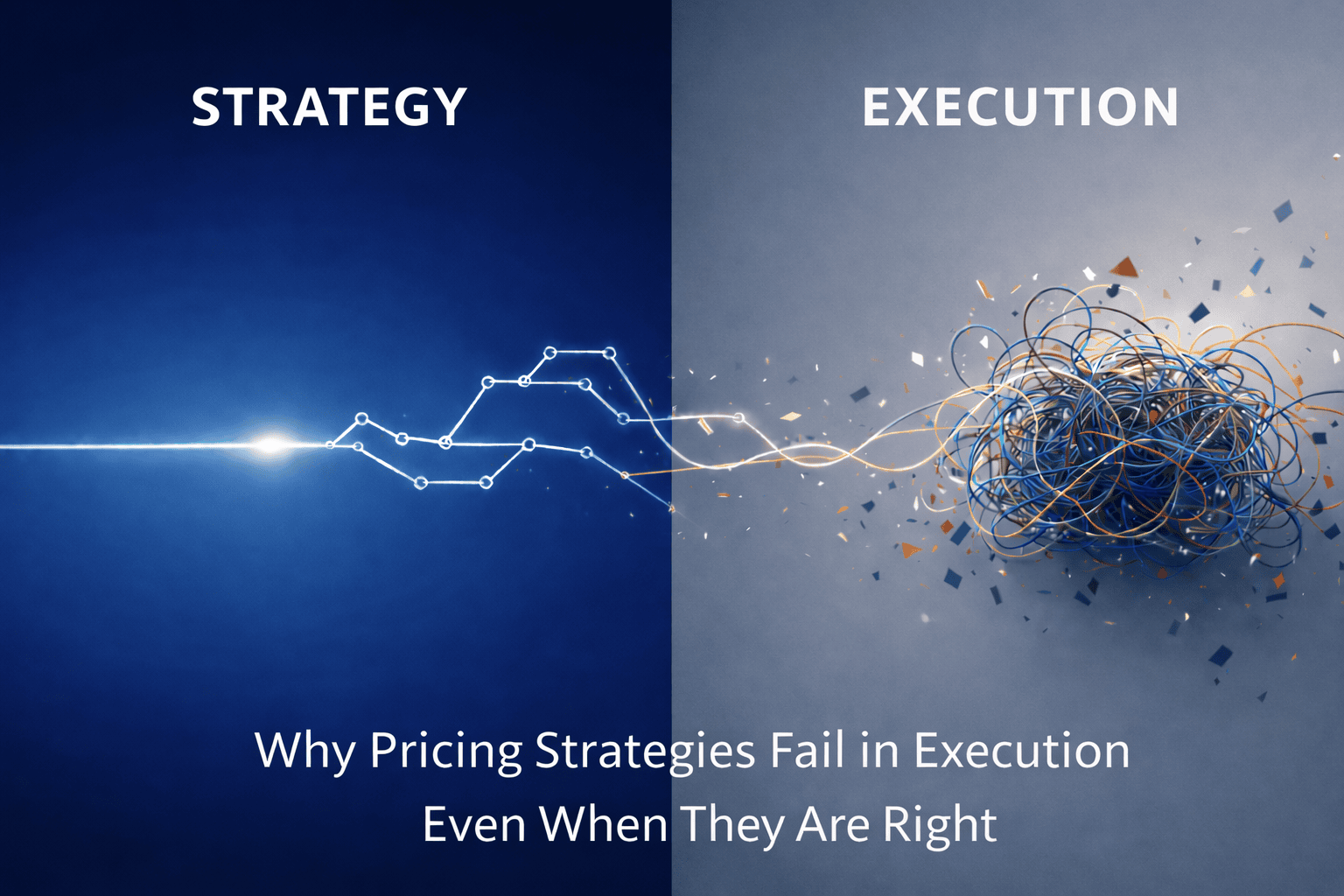
Pricing strategy rarely fails because the thinking is wrong.
Most organizations invest serious effort in understanding their markets, defining competitive positioning, and articulating how pricing should support growth and margin objectives. Product teams deliver on plan. Go-to-market strategies are defined. Target segments are identified. Channels are aligned. There is a clear point of view on the value being delivered and what customers should be charged across different scenarios. At a strategic level, pricing intent is well articulated.
And yet, pricing consistently underperforms relative to that intent.
The gap between what pricing should do and what it actually delivers is one of the most persistent and costly problems in commercial operations. It is also one of the most misunderstood. When pricing outcomes fall short, the instinct is to revisit the strategy itself, to question the segmentation, the positioning, or the price points. But in most cases, the strategy is not the problem. The problem is what happens after the strategy is defined.
Where Intent Meets Reality
The challenge begins the moment pricing intent moves into execution.
At this point, pricing must operate within real world conditions that vary significantly across markets. Competitive dynamics differ by geography and channel. Distributor and partner agreements introduce non standard price structures and constraints. Volume based rebates, incentives, and programs add additional layers of logic. New competitors emerge faster than pricing benchmarks can be refreshed.
What started as a manageable set of pricing decisions quickly expands into hundreds or thousands of combinations that must be calculated, approved, governed, and maintained. Each market introduces its own variables. Each customer segment carries its own expectations. Each channel demands its own economics.
This is where complexity overwhelms capability. Not because the people involved lack skill or judgment, but because the operating environment has grown beyond what informal, manual processes can reliably manage.
The Execution Model Was Never Designed for This
In many organizations, the tools and processes used to execute pricing were established during a period of far lower complexity. Price lists were maintained in spreadsheets. Approvals were handled through email. Discount decisions were made on a deal by deal basis, governed by relationships and precedent rather than structured policy. These methods worked when the number of pricing decisions was small, the pace of change was slow, and the consequences of inconsistency were contained.
That environment no longer exists for most businesses.
As organizations have expanded across products, geographies, channels, and customer segments, the volume and velocity of pricing decisions have increased dramatically. But the execution model, the combination of people, processes, systems, and data that translates pricing intent into market outcomes, has not kept pace.
Pricing teams fall back on spreadsheets and manual processes to apply rules that are static, fragmented, and difficult to govern. Each exception adds another layer of workaround. Each market change increases the distance between what pricing was designed to do and what it actually does. The execution infrastructure bends, and eventually it breaks. Not in a single dramatic failure, but through a slow accumulation of inconsistencies, overrides, and gaps that erode value quietly over time.
The Cost of the Gap
The consequences of this execution gap are both measurable and compounding.
At the transaction level, pricing intent erodes through unmanaged discounts, inconsistent exceptions, and decisions made under commercial pressure with limited visibility into downstream impact. What should be a governed outcome becomes a negotiated one, shaped more by urgency and individual judgment than by strategy and discipline.
At the portfolio level, these individual deviations aggregate into structural margin leakage. Approved pricing and realized pricing diverge. Programs and incentives interact in unintended ways. Performance monitoring, if it exists at all, is backward looking and fragmented, revealing problems only after they have been embedded in contracts, relationships, and customer expectations.
At the organizational level, the gap consumes bandwidth. Pricing teams spend their time managing mechanics rather than informing decisions. Governance becomes reactive. Learning does not compound because the same issues recur cycle after cycle, addressed through manual correction rather than systemic improvement.
The cost is not limited to margin. It includes the opportunity cost of a pricing function that cannot operate at the speed, scale, or precision the business requires.
Why This Problem Persists
If the diagnosis is straightforward, that pricing strategy is sound but execution cannot deliver on it, the obvious question is why the problem persists.
Three factors explain its durability.
First, the gap is difficult to see. Pricing erosion does not announce itself. It accumulates gradually across transactions, markets, and time periods. Without structured monitoring and clear measurement, the distance between intent and outcome is invisible to the people responsible for closing it.
Second, the gap is distributed. No single team or function owns the entire pricing workflow. Strategy is set in one place. Design happens in another. Governance sits with a third group. Execution depends on systems managed by IT. Transactions are controlled by sales. When no one owns the end to end flow, no one is accountable for end to end performance.
Third, the gap is tolerated. In many organizations, pricing execution problems are treated as an unavoidable cost of doing business, a natural consequence of market complexity. This normalization prevents the kind of focused investment that would be directed at any other operational capability delivering below its potential.
Reframing the Problem
Addressing the execution gap does not require rethinking pricing strategy. It requires rethinking pricing as an operational capability.
This means recognizing that pricing is not a series of isolated decisions. It is a continuous, governed workflow, from the moment strategic intent is defined through design, governance, execution, transactional application, monitoring, and learning. Each step in that workflow either preserves or erodes the value that pricing strategy was designed to create.
When organizations view pricing through this lens, the path forward becomes clearer. The question shifts from "Is our pricing strategy right?" to "Does our operating model allow our pricing strategy to work?" That shift, from strategy to capability, is where pricing transformation actually begins.
It does not require a complete overhaul. It requires identifying which steps of the pricing workflow are constraining results today, which dimensions of the operating model are causing friction, and where targeted improvement will deliver the greatest return.
Pricing transformation is not about reaching an abstract end state. It is about progressively removing the constraints that prevent pricing from delivering its intended value. With the right framework, the right focus, and the right enablers, pricing becomes not just manageable, but a durable source of competitive advantage.
This is the first in a series exploring how organizations can connect pricing intent to execution through disciplined operating models, clear governance, and scalable workflows.