
For a structured view of how pricing intent connects to execution through operating models, governance, and scalable workflows, download the full Pricing Operating Model whitepaper.
Most pricing conversations focus on strategy. What should we charge? How should we segment? Where should we position relative to competitors? These are important questions. But they are only half the picture.
A pricing strategy defines intent. It articulates what the organization wants pricing to achieve. A pricing operating model defines how that intent is actually carried out, day after day, across every product, customer, channel, and market where pricing decisions are made.
The distinction is critical because strategy and execution are not automatically connected. A well articulated pricing strategy does not guarantee well executed pricing. In fact, the most common pattern in organizations with mature pricing thinking is exactly this: the strategy is sound, but the execution falls short because the operating model cannot support it.
What a Pricing Operating Model Actually Is
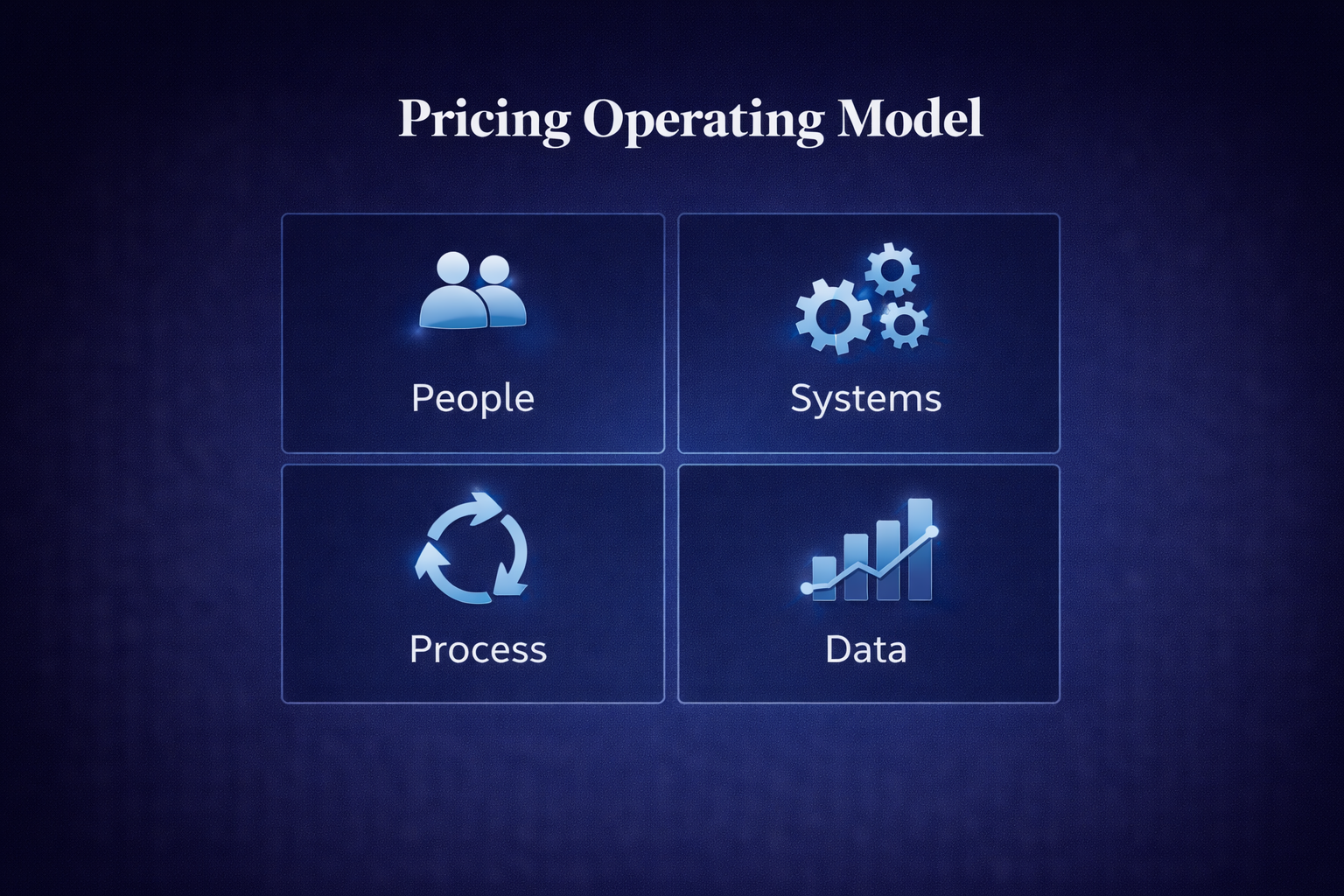
A pricing operating model is the structured combination of people, processes, systems, and data that translates pricing strategy into repeatable, governed outcomes. It is not a single tool, a team structure, or a set of policies in isolation. It is how all of these elements work together to produce consistent pricing behavior across the organization.
Think of it this way. Strategy defines what should happen. The operating model determines what actually happens.
When the operating model is strong, pricing decisions are made consistently. Governance is clear. Execution is reliable. Performance is visible. When the operating model is weak, pricing defaults to whatever each team, region, or individual can manage on their own. Consistency breaks down. Exceptions multiply. The gap between intent and outcome widens.
The Four Dimensions
A pricing operating model operates across four core dimensions. Each one plays a distinct role, and weakness in any one of them limits the effectiveness of the others.
People encompasses the roles, skills, and accountability structures that define who is responsible for pricing decisions. This includes where pricing expertise resides in the organization, how it is structured, and how pricing authority is distributed. When the people dimension is weak, pricing decisions are made by whoever happens to be closest to the transaction, regardless of whether they have the context or authority to make them well.
Process encompasses the workflows, rules, and governance mechanisms that define how pricing decisions are made, approved, and executed. This includes everything from how pricing intent is translated into executable rules, to how exceptions are managed, to how performance is reviewed. When the process dimension is weak, pricing becomes ad hoc. Each situation is handled differently, and institutional knowledge is trapped in the heads of a few individuals rather than embedded in repeatable workflows.
Systems encompasses the tools and platforms used to design, govern, and execute pricing. This includes pricing software, ERP and CPQ integrations, and the data infrastructure that supports pricing decisions. When the systems dimension is weak, pricing logic is scattered across spreadsheets, emails, and disconnected applications. Execution is manual, error prone, and impossible to audit.
Data encompasses the inputs used to inform pricing decisions and the outputs used to measure performance. This includes cost data, market signals, customer behavior, competitive intelligence, and pricing outcomes. When the data dimension is weak, decisions are made on assumptions rather than evidence, and performance gaps go undetected because there is no structured way to measure them.
Why Strategy Alone Is Not Enough
A pricing operating model can only execute what pricing strategy makes explicit. It cannot invent segmentation logic, define customer value, or resolve strategic trade offs. When the operating model is forced to fill gaps that strategy left open, it defaults to what it can enforce mechanically: rules, approvals, and constraints that may or may not reflect the organization’s actual intent.
This is why pricing transformation is not primarily a tooling or data problem. It starts with making pricing strategy complete enough to be executed. That means resolving trade offs explicitly, defining priorities clearly, and articulating guardrails that downstream teams can act on without having to reinterpret strategic intent on the fly.
Once strategy is explicit, the operating model can do its job: express that intent consistently and repeatedly over time.
But even the most explicit strategy will fail if the operating model cannot carry it. A brilliant segmentation strategy is worthless if the systems cannot differentiate pricing by segment. A carefully designed discount policy is meaningless if approvals are routinely bypassed. A value based pricing framework contributes nothing if sales teams have no visibility into the value drivers that justify the price.
Strategy sets direction. The operating model makes it real.
What Happens Without One
Organizations without a deliberate pricing operating model do not stop making pricing decisions. They simply make them inconsistently.
Pricing intent gets reinterpreted at every handoff. The strategy team articulates one direction. The pricing analysts translate it into something slightly different. The systems team implements what they can given existing constraints. Sales executes based on their own understanding and incentives. By the time a price reaches the customer, it may bear little resemblance to what was originally intended.
Exceptions become the norm rather than the exception. Without clear governance, every deal becomes a special case. Discount requests are approved based on relationships and urgency rather than policy. Over time, the exception behavior becomes the actual pricing behavior, and the original strategy exists only on a slide deck that no one references.
Performance is invisible. Without structured monitoring, the organization has no way to know whether pricing is performing as intended. Margin leakage, discount creep, and execution errors go undetected until they show up in aggregate financial results, at which point the root causes are difficult to trace.
The absence of an operating model does not mean pricing is not happening. It means pricing is happening without control, visibility, or the ability to improve.
Building the Foundation
The value of a pricing operating model is not theoretical. It is the difference between pricing that degrades over time and pricing that improves over time.
Building one does not require a massive transformation. It requires clarity about how pricing decisions are currently made, where the gaps and friction points exist, and which improvements will create the most value. Some organizations need to start with clearer decision rights. Others need better systems integration. Others need structured governance where none exists today.
The starting point varies. What does not vary is the principle: pricing performance is a function of the operating model, not just the strategy. Organizations that invest in building a deliberate, structured operating model create the conditions for pricing to perform consistently, adapt to change, and compound value over time.
Those that do not will continue to wonder why a strategy that looks right on paper never quite delivers in the market.
This is the fourth in a series exploring how organizations can connect pricing intent to execution through disciplined operating models, clear governance, and scalable workflows.