
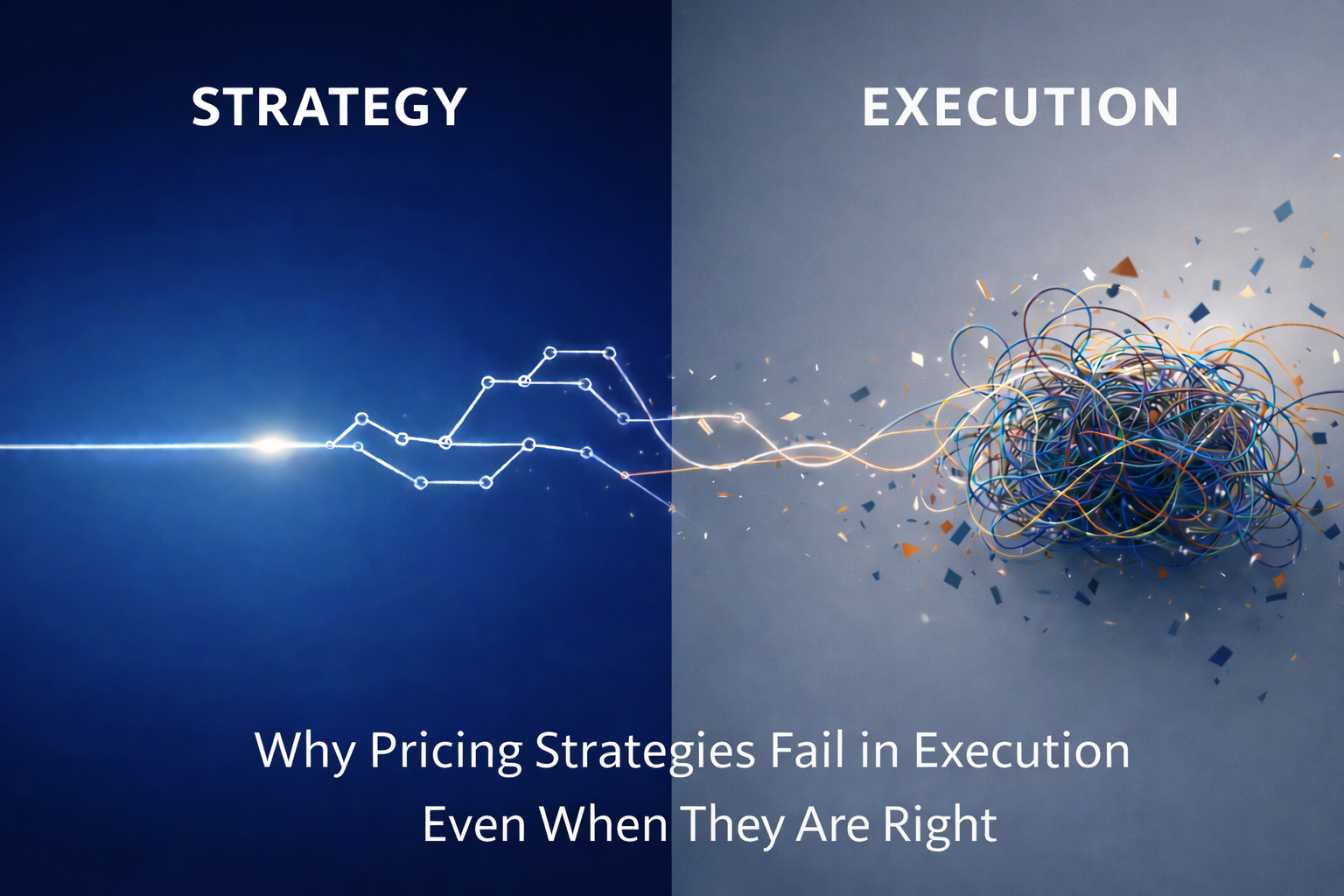
For a structured view of how pricing intent connects to execution through operating models, governance, and scalable workflows, download the full Pricing Operating Model whitepaper.
Of the four dimensions of a pricing operating model, people, process, systems, and data, the people dimension is simultaneously the most important and the most neglected.
Organizations invest significant effort in pricing processes, tools, and analytics. These investments are visible, measurable, and relatively straightforward to plan. The people dimension is none of those things. It involves organizational design, decision rights, cultural dynamics, and the messy reality of how authority, expertise, and accountability are distributed across functions.
Yet when pricing underperforms, the root cause is more often found in the people dimension than in any other. Not because the individuals lack skill, but because the organizational structure does not support consistent, governed pricing execution.
The Ownership Problem
The most fundamental people challenge in pricing is ownership.
In most organizations, pricing is distributed across multiple functions. Strategy may sit with leadership or product. Design and analysis may sit with a pricing team or finance. Governance may sit with sales leadership. Execution depends on IT and operations. Monitoring falls to finance or business intelligence. Each function owns a piece of the workflow, but no single function owns the whole.
This fragmentation means that no one is accountable for end to end pricing performance. Each function optimizes its own portion, often without visibility into how its decisions affect the rest of the chain. Strategy sets direction without understanding execution constraints. Governance approves exceptions without seeing their cumulative impact. Sales negotiates deals without awareness of portfolio level economics.
The result is pricing that works in segments but fails as a system. The individual pieces may each be reasonable, but the collective outcome does not reflect the organization’s actual intent.
Decision Rights and Authority
Closely related to ownership is the question of decision rights. In many organizations, pricing authority is ambiguous, contested, or informally held.
When decision rights are unclear, pricing decisions default to whoever has the most leverage in the moment. In commercial settings, that is usually sales. Not because sales is trying to circumvent pricing policy, but because sales faces the customer, carries the revenue target, and has the most immediate incentive to close the deal. In the absence of clear pricing authority, commercial pressure fills the vacuum.
When decision rights are contested, pricing becomes political. Different functions advocate for different outcomes based on their own objectives. Finance pushes for margin. Sales pushes for volume. Product pushes for adoption. Without a clear arbiter, these conflicts are resolved through hierarchy, relationships, or attrition rather than through a structured process.
Effective pricing requires that decision rights are explicit, documented, and respected. This does not mean centralizing all pricing authority in a single person or team. It means defining who has authority over what, under what conditions, and how conflicts are escalated when they arise.
Skills and Organizational Placement
Where pricing expertise sits in the organization matters more than most leaders realize.
When pricing is embedded within sales, it tends to be optimized for deal velocity and customer accommodation. When it sits within finance, it tends to be optimized for margin protection and cost recovery. When it sits within product, it tends to focus on list pricing and positioning. None of these orientations is wrong, but each one produces a pricing function with blind spots.
The organizations that manage pricing most effectively tend to position it as a function that operates across these boundaries. This might mean a dedicated pricing team that reports to a Chief Commercial Officer or Chief Revenue Officer, or a cross functional pricing council that brings together representatives from sales, finance, product, and operations.
The specific structure matters less than the principle: pricing needs enough independence to make decisions that are not solely driven by any single function’s priorities, and enough connectivity to stay grounded in commercial reality.
Skills matter as well. Pricing requires a combination of analytical capability, commercial judgment, strategic thinking, and operational discipline. Finding all of these in a single individual is rare. Building a team that covers all of them is achievable but requires deliberate design.
Insulating Pricing from Short Term Pressure
One of the most important but least discussed aspects of organizational design for pricing is insulation from short term commercial pressure.
Every organization faces moments where the temptation to override pricing governance is intense. A quarter end push to meet revenue targets. A competitive threat that demands an immediate response. A strategic account that expects special treatment. In these moments, pricing integrity is tested, and the outcome depends on whether the organization has built structural safeguards or relies on individual resolve.
Individual resolve is not enough. When pricing authority is held by people who also carry revenue targets, the conflict of interest is inherent. The solution is not to remove commercial awareness from pricing, but to ensure that pricing decisions are governed by people and processes that can weigh short term commercial benefit against long term pricing integrity.
This is an organizational design choice, not a policy choice. It requires that pricing leadership has the standing, the data, and the mandate to push back when short term pressure threatens long term value. Organizations that build this into their structure protect pricing intent more consistently than those that rely on individual courage to hold the line.
This is the fifteenth in a series exploring how organizations can connect pricing intent to execution through disciplined operating models, clear governance, and scalable workflows.