
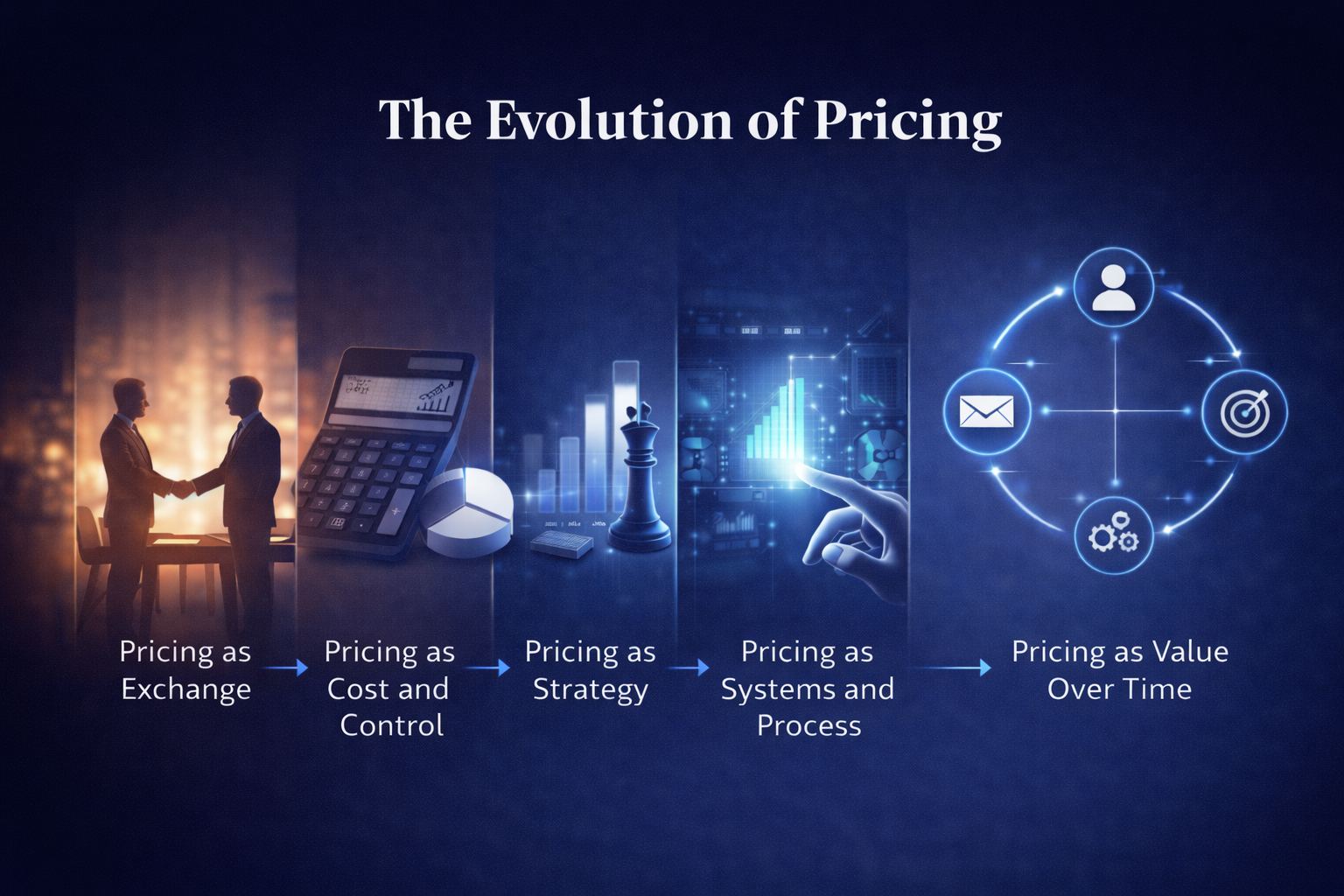
Pricing as Exchange
For a structured view of how pricing intent connects to execution through operating models, governance, and scalable workflows, download the full Pricing Operating Model whitepaper.
Before formal business structures existed, pricing was the result of direct negotiation between buyer and seller. Value was determined through scarcity, bargaining power, and supply and demand. There was no internal pricing logic to speak of. The price was whatever two parties agreed to in the moment.
This is the oldest form of pricing, and its influence is more durable than most organizations realize. In many B2B environments today, pricing still defaults to this mode when governance breaks down. When a sales team negotiates a deal without reference to a pricing framework, they are effectively operating in the same paradigm that existed centuries ago, discovering the price at the point of sale through individual judgment and negotiation dynamics.
Pricing as Cost and Control
As businesses formalized in the early to mid 1900s, pricing shifted toward internal management. Cost based models became the standard. Organizations calculated their costs, applied a target margin, and published price lists that were updated periodically.
This era introduced important concepts: standardization, price lists, and financial controls. It also introduced a limitation that persists in many organizations today, the assumption that pricing is primarily a finance and accounting function. When pricing is anchored to cost, it becomes a calculation rather than a decision. The market, the customer, and the competitive landscape are secondary inputs at best.
For many companies, this model worked well enough when competition was stable, product portfolios were narrow, and customers had limited alternatives. It could not, however, account for how different customers perceived and valued the same product differently.
Pricing as Strategy
The late 1900s brought a fundamental shift. Organizations began treating pricing as a strategic lever rather than a cost recovery mechanism. Concepts like value based pricing, segmentation, discount governance, and competitive positioning entered the vocabulary.
This was a significant advancement. Pricing was no longer just about covering costs and generating margin. It became about capturing value, shaping customer behavior, and supporting competitive differentiation. Pricing teams began to emerge as distinct functions within organizations.
But this era also introduced a tension that many companies still struggle with. Strategic pricing requires a level of analytical sophistication and organizational alignment that most operating models were not designed to support. The strategy was often sound, but the mechanisms for executing it consistently across products, markets, and channels lagged behind.
Pricing as Systems and Process
As scale and complexity increased through the early 2000s, organizations turned to systems to manage pricing. Pricing logic was embedded into ERPs, CPQ platforms, and spreadsheets. Rules were codified. Workflows were formalized. Automation replaced some manual processes.
This was a necessary evolution. Without systems, pricing at scale is simply not feasible. But the way systems were implemented often created new problems. Pricing logic was scattered across multiple platforms with no single source of truth. Rules were hard coded and difficult to update. Spreadsheets remained the connective tissue between systems, introducing fragility and risk.
The result was that pricing became more scalable but also more rigid. Organizations could execute pricing at volume, but adapting to changing conditions required significant effort. The systems that were meant to enable pricing often became constraints on it.
Pricing as Value Over Time
Today, pricing has evolved into something far more complex and far more consequential than any previous era anticipated.
Modern pricing must balance transactional outcomes with longer term objectives. Customer lifetime value, program economics, portfolio performance, and channel dynamics all influence how prices should be set and managed. Pricing is no longer a point in time decision. It is a continuous activity that must adapt to changes in markets, customers, and competition without losing governance or strategic intent.
This requires pricing to operate with a combination of speed, flexibility, and discipline that previous models were never designed to deliver. Cost based approaches cannot account for customer value differences. Strategic frameworks cannot scale without systems. Systems cannot adapt without structured feedback loops. And none of it works without clear governance and ownership.
The organizations that succeed in this environment are the ones that have built pricing into an enterprise capability, connecting strategy to execution through a governed operating model that evolves as the business evolves.
Why the History Matters Now
The reason this evolution matters is practical, not historical. Most organizations are not operating cleanly within a single era. They carry forward assumptions, processes, and tools from every stage of pricing’s development.
A company might have a sophisticated pricing strategy that reflects the latest thinking on value based segmentation, but execute that strategy through spreadsheets and manual approvals that belong to the cost and control era. It might have invested in systems that automate price execution, but lack the governance structures to prevent those systems from being overridden at the point of sale.
These mismatches are the root cause of most pricing performance gaps. The strategy has evolved. The operating model has not.
Closing that gap starts with recognizing where the organization actually stands today, not where it aspires to be, and then building the capability to move forward deliberately. That is what a modern pricing operating model is designed to do.
This is the third in a series exploring how organizations can connect pricing intent to execution through disciplined operating models, clear governance, and scalable workflows.