
For a structured view of how pricing intent connects to execution through operating models, governance, and scalable workflows, download the full Pricing Operating Model whitepaper.
Governance and approval sit at a critical point in the pricing workflow. This is where pricing decisions are reviewed against the intent and guardrails established in earlier steps, and where the organization decides whether to proceed, adjust, or escalate.
Done well, governance protects pricing intent without slowing execution unnecessarily. Done poorly, it becomes one of two things: either a bottleneck that frustrates commercial teams and delays decisions, or a formality that exists on paper but is routinely bypassed in practice. Neither outcome serves the business.
The purpose of governance is not to approve or reject every pricing decision. It is to ensure that decisions are made consistently, transparently, and in alignment with the strategy and guardrails the organization has defined. It exists to introduce control where value, risk, or policy exposure justifies it, and to do so deliberately rather than reflexively.
What Governance Should Produce
Effective pricing governance produces several things that the organization depends on but often takes for granted.
Clear decision rights and authority. The organization should know, without ambiguity, who has the authority to approve pricing decisions at each level. This includes defined escalation paths for higher risk or out of policy situations, and separation between who recommends a price and who gives final approval.
Approval thresholds and policies. Not every pricing decision requires the same level of scrutiny. Governance should define thresholds based on value, risk, or deviation from intent. A standard deal within established guardrails should not require the same approval process as a large exception that deviates significantly from policy.
Structured workflows. The mechanics of how pricing decisions are submitted, reviewed, and approved should be defined and repeatable. Ad hoc approval processes produce ad hoc outcomes.
Exception management. Every organization has exceptions. What distinguishes mature governance is that exceptions are defined, tracked, and justified rather than treated as routine. The frequency and pattern of exceptions should be visible to pricing leadership, not buried in individual deal records.
Traceability. Every approval decision should be documented with rationale. This is not about creating paperwork. It is about building an institutional record that enables the organization to learn from its decisions over time.
When Governance Breaks Down
Governance breakdowns rarely happen all at once. They accumulate gradually, often starting with reasonable accommodations that become permanent behaviors.
A sales leader approves an exception to close a quarter end deal. The exception works, so it happens again. Over time, the exception becomes the standard, and the original pricing intent is effectively overwritten by accumulated ad hoc decisions. No one made a deliberate choice to change the strategy. The strategy simply eroded because governance was not strong enough to hold the line.
Bypass is another common pattern. When approval processes are too slow or too rigid, commercial teams find ways around them. Deals get structured to fall just below approval thresholds. Discounts are applied after the fact. Pricing changes are made directly in transactional systems without going through the governance workflow. The governance framework still exists on paper, but it no longer reflects how decisions are actually made.
The cost of these breakdowns is not limited to individual transactions. When governance is weak, the organization loses its ability to manage pricing as a system. Margin leakage increases. Pricing behavior becomes inconsistent across teams and regions. And the feedback loop between intent and outcome breaks, because the decisions being made no longer reflect the decisions that were planned.
The Speed and Control Trade Off
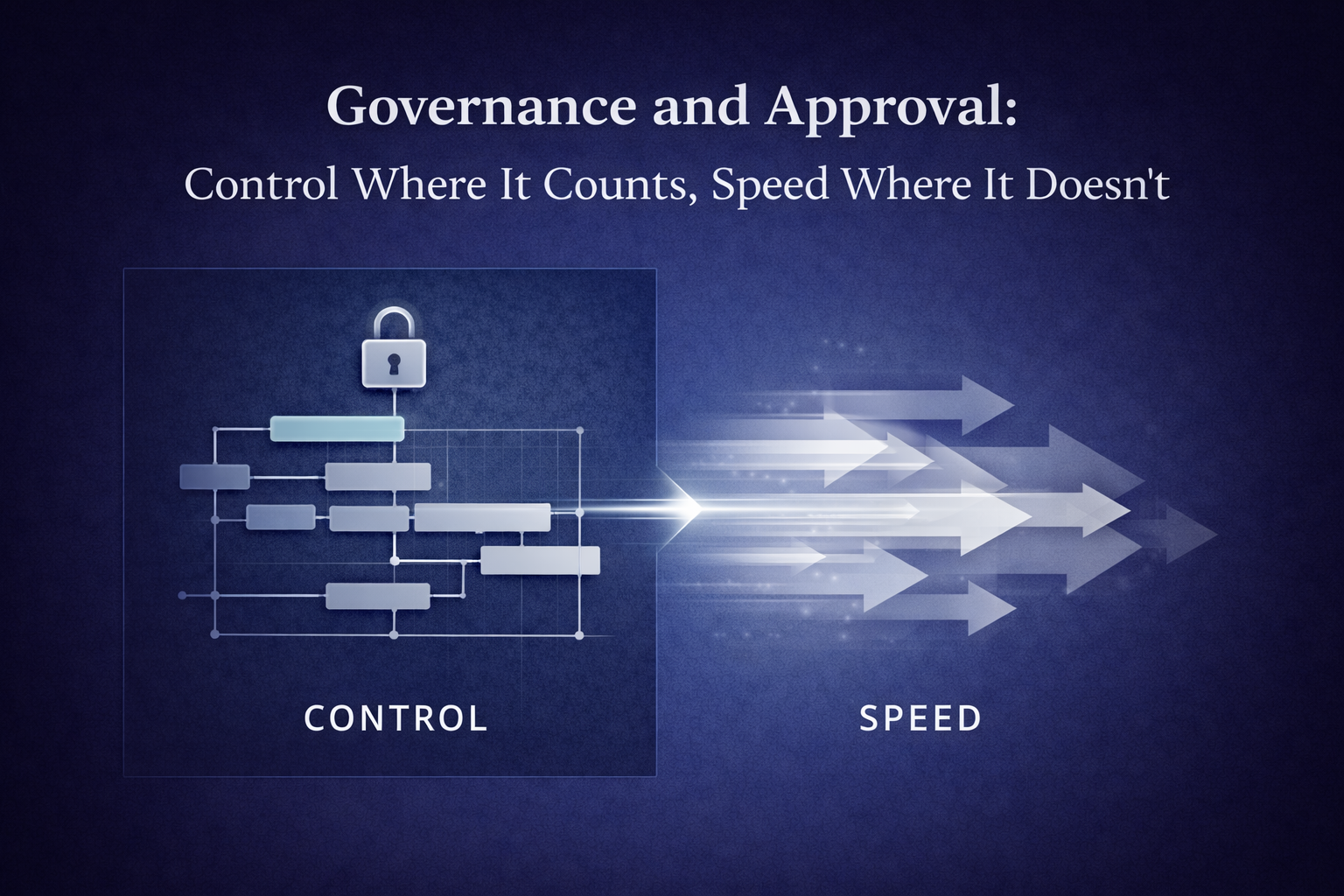
One of the most common objections to pricing governance is that it slows things down. This objection is valid when governance is designed poorly. If every pricing decision requires multiple levels of approval regardless of its risk profile, governance becomes a bottleneck that drives workaround behavior.
But this is not a flaw in governance itself. It is a flaw in how governance is designed.
Mature governance differentiates between low risk and high risk decisions. Low risk decisions, those that fall within established guardrails and involve standard pricing logic, should move quickly with minimal intervention. High risk decisions, those that involve significant deviation from policy, large dollar exposure, or strategic implications, should receive proportionally more scrutiny.
This risk based approach allows governance to protect intent without becoming a constraint on commercial velocity. It also focuses the time and attention of pricing leaders where it matters most, on the decisions that carry the greatest value or risk, rather than on routine approvals that can be automated or pre authorized.
The goal is not fewer controls. It is smarter controls. Governance should be a mechanism for enabling speed on the decisions that warrant it, while ensuring discipline on the decisions that require it.
Building Governance That Lasts
Governance is not a one time implementation. It is a living system that must evolve with the business.
As the organization matures, governance should become more adaptive. Early stage governance often applies uniform controls across all decisions because the organization lacks the data or confidence to differentiate. Over time, as performance data accumulates and patterns become visible, governance can shift toward a model where control intensity adjusts based on observed risk and behavior.
This progression requires investment in visibility. If the organization cannot see approval volumes, cycle times, exception rates, and escalation patterns, it cannot calibrate governance effectively. It will either over control, creating friction, or under control, allowing erosion.
It also requires cultural alignment. Governance works when the people operating within it understand its purpose and see it as a tool for enabling better outcomes, not as an obstacle to commercial execution. When governance is perceived as punitive or arbitrary, it invites resistance. When it is perceived as a shared framework for protecting pricing integrity, it becomes something teams actively support.
The organizations that build durable governance systems do not treat them as compliance exercises. They treat them as strategic infrastructure, something that compounds value over time by ensuring that pricing decisions remain aligned with intent, even as the volume and complexity of those decisions increase.
This is the seventh in a series exploring how organizations can connect pricing intent to execution through disciplined operating models, clear governance, and scalable workflows.
Vice President of Marketing and Sales
Chris Newton is Vice President of Marketing and Sales at IMA360, where he leads brand strategy, market expansion, and customer engagement. With a background spanning commercial strategy and revenue operations, Chris works closely with enterprise teams navigating the complexities of pricing, programs, and profit optimization.
Explore IMA360 Solutions
Complexity Simplified. Your Results Amplified.
Ready to Modernize Your Pricing?
See how IMA360 bridges the gap between pricing intent and execution for measurable results.