
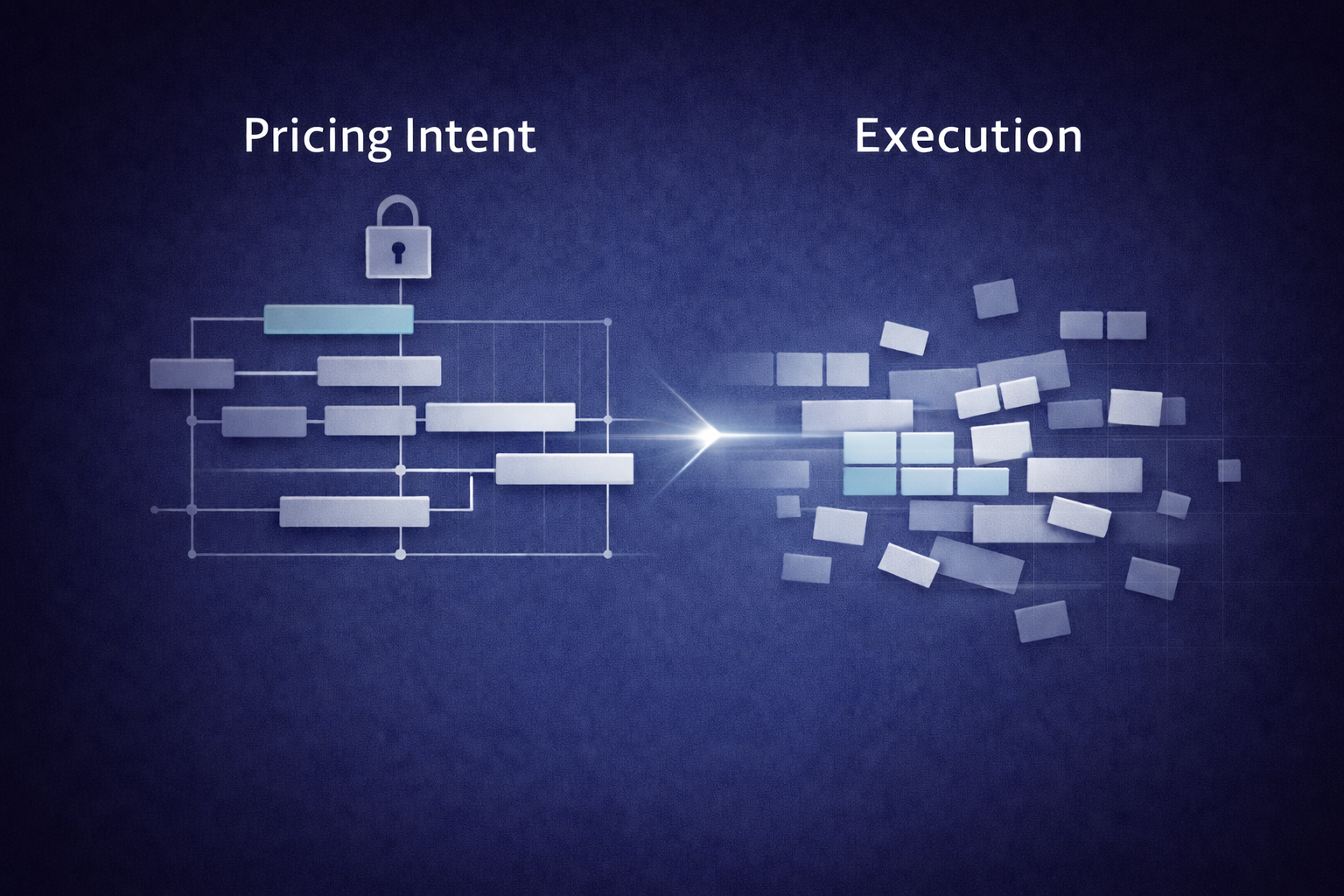
For a structured view of how pricing intent connects to execution through operating models, governance, and scalable workflows, download the full Pricing Operating Model whitepaper.
Execution and deployment sits at the midpoint of the pricing workflow. Everything upstream, strategy, design, governance, has been about defining and approving what pricing should do. Everything downstream, transactional application, monitoring, learning, depends on execution being accurate.
This step is where approved pricing decisions are translated into live transactional systems. It is the bridge between what was decided and what actually happens in the market. And it is one of the most underinvested steps in most pricing operating models.
The reason is straightforward. Execution and deployment is perceived as an operational task rather than a strategic one. It does not involve the intellectual challenge of pricing strategy or the organizational politics of governance. It is data entry, system configuration, and coordination across teams. It is unglamorous work.
But it is also the step where pricing intent is most vulnerable to silent erosion. A strategy can be brilliant. A design can be precise. Governance can be rigorous. And all of it can be undone by a deployment that introduces errors the organization does not know exist.
How Pricing Erodes at Deployment
Deployment failures rarely announce themselves. They accumulate quietly through several recurring patterns.
Manual entry is the most common source of error. When approved prices must be entered by hand into one or more systems, transcription errors are inevitable. A decimal point shifts. A customer code is mismatched. An effective date is entered incorrectly. Each error is small in isolation, but across hundreds or thousands of price points, the aggregate impact on revenue and margin can be substantial.
System drift occurs when pricing logic exists in multiple systems that are not synchronized. The price in the ERP may differ from the price in the CPQ tool. The contract management system may reference an outdated rate. Billing may apply a different discount structure than what was quoted. When systems are not aligned, the customer experience becomes inconsistent and the organization loses visibility into what price is actually being charged.
Local reinterpretation happens when regional or functional teams adjust deployment to accommodate local constraints without formal approval. A price structure that was designed for global consistency gets modified for a specific market. A discount rule gets softened to avoid customer pushback. These adjustments may be well intentioned, but they introduce variation that is invisible to the teams responsible for pricing integrity.
Timing gaps create risk when there is a delay between approval and deployment. In fast moving markets, a price that was appropriate when approved may no longer be competitive or margin protective by the time it reaches the system. If deployment cycles are long or unpredictable, the organization is always executing on yesterday’s decisions.
Why Deployment Gets Overlooked
Deployment is overlooked for structural reasons, not because anyone considers it unimportant.
Ownership is often fragmented. Pricing teams define what should be deployed. IT teams manage the systems where deployment happens. Commercial operations coordinate timing and scope. When no single team owns the end to end deployment process, accountability gaps emerge at every handoff.
Measurement is rare. Most organizations track whether a deployment was completed, but few track whether it was completed accurately. Without a systematic comparison between approved pricing and deployed pricing, errors go undetected until they surface through customer complaints, margin analysis, or audit findings.
Investment is minimal. Deployment is treated as a cost center activity rather than a value protection function. Automation is limited. Validation checks are manual or nonexistent. The tools available to deployment teams are often the same spreadsheets and email chains that the organization uses for everything else.
The result is that deployment operates below the threshold of organizational attention. Problems are addressed one at a time as they are discovered, rather than prevented systematically. And the cumulative cost of this approach, in margin leakage, rework, and customer friction, is far higher than most organizations realize.
What Good Deployment Looks Like
Effective deployment is defined by a few principles.
What was approved is exactly what goes live. This sounds obvious, but achieving it requires deliberate process design. Deployment workflows should include validation steps that compare approved pricing to what has been entered into execution systems. Discrepancies should be flagged before they reach the market.
Deployment is synchronized across systems. When pricing logic exists in multiple platforms, updates must be coordinated to prevent conflicting or duplicated rules. A single source of truth for pricing, from which all systems are updated, significantly reduces the risk of drift.
Timing is controlled and predictable. Deployment cycles should be aligned with commercial strategy. The organization should know when prices go live, across which products and markets, and should have the ability to sequence deployments deliberately rather than reactively.
Ownership is clear. Someone must be accountable for ensuring that deployment is complete, accurate, and timely. This does not mean a single person does all the work. It means a single function or role owns the process and is responsible for its outcomes.
Deployment is auditable. The organization should be able to trace any deployed price back to its approval. Change history should be visible. Deployment errors should be trackable so that patterns can be identified and root causes addressed.
The Strategic Case for Investing in Deployment
Organizations that treat deployment as a strategic function rather than an administrative task gain a significant advantage.
They move faster because automated, validated deployment workflows reduce the cycle time between approval and market execution. They lose less because structured validation catches errors before they reach customers. They adapt better because repeatable deployment processes make it possible to update pricing frequently without introducing chaos.
Most importantly, they preserve the value created by every step upstream. A pricing organization can invest heavily in strategy, design, and governance, but if deployment fails, all of that investment leaks through the execution gap.
Deployment is not where pricing strategy is created. But it is where pricing strategy either survives or dies. Organizations that recognize this and invest accordingly protect more value with less effort than those that continue to treat deployment as someone else’s problem.
This is the eighth in a series exploring how organizations can connect pricing intent to execution through disciplined operating models, clear governance, and scalable workflows.